Reagan’s Financial Arrangements: Reaganomics Explained
The term “Reaganomics” refers to the economic policies promoted by President Ronald Reagan during the 1980s. These policies were based on the principles of supply-side economics and represented a significant shift in American fiscal policy.
The Four Pillars of Reaganomics
Reagan’s economic program was built on four key principles:
- Reduce Government Spending: Reagan aimed to reduce the growth of government spending, particularly on domestic programs, while maintaining strong defense spending.
- Reduce Income Tax and Capital Gains Tax: The Economic Recovery Tax Act of 1981 reduced the top marginal tax rate from 70% to 50%, and the Tax Reform Act of 1986 further reduced it to 28%.
- Reduce Government Regulation: Reagan sought to reduce the burden of government regulation on businesses, believing that deregulation would stimulate economic growth.
- Tighten the Money Supply: Working with the Federal Reserve, Reagan supported policies to reduce inflation through tighter monetary policy.
Supply-Side Economics
The theoretical foundation of Reaganomics was supply-side economics, which holds that economic growth can be most effectively achieved by lowering taxes and decreasing regulation. The theory suggests that lower tax rates would stimulate investment and job creation, ultimately generating more tax revenue despite the lower rates.
The Laffer Curve
A key concept in Reagan’s economic philosophy was the Laffer Curve, which suggests that there is an optimal tax rate that maximizes government revenue. According to this theory, if tax rates are too high, they discourage economic activity and actually reduce total tax revenue.
Impact and Legacy
Reagan’s financial arrangements had significant effects on the American economy:
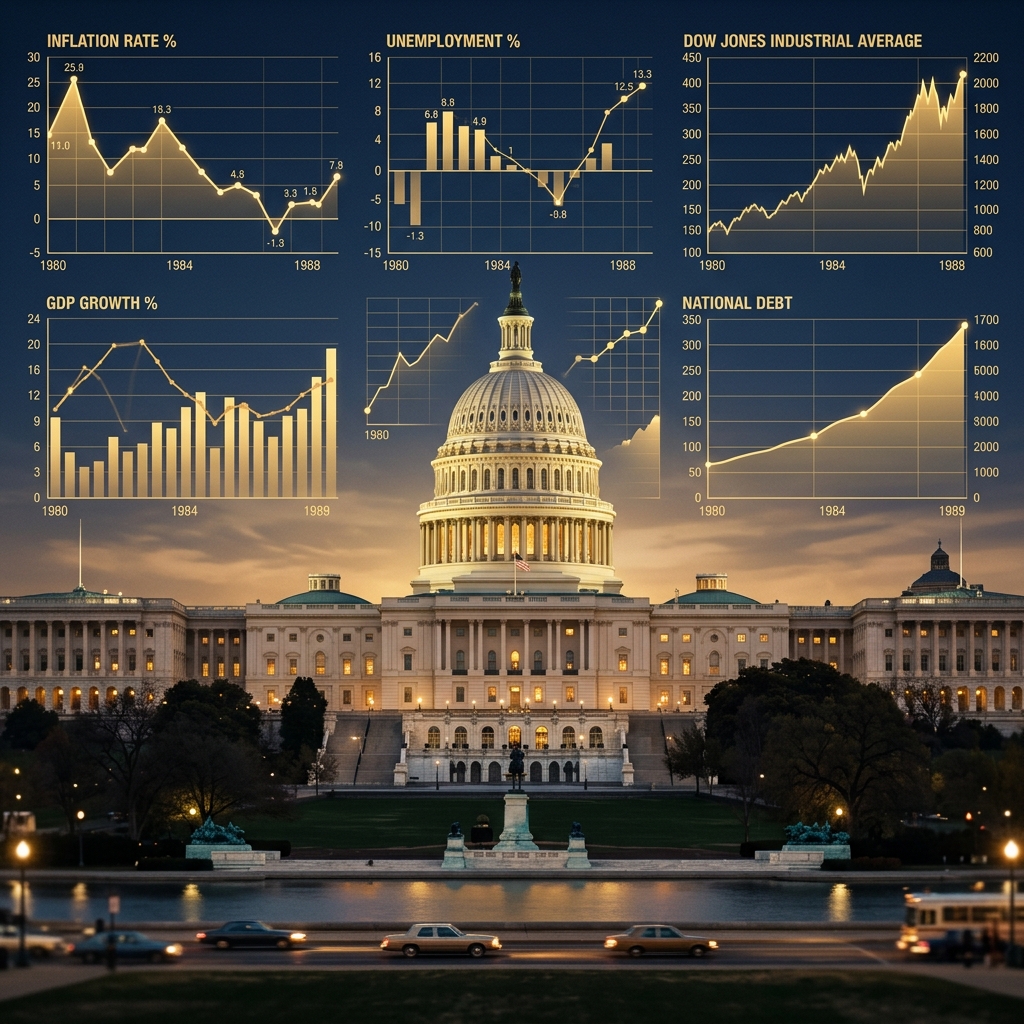
- GDP growth averaged 3.5% during Reagan’s presidency.
- Inflation dropped from 13.5% in 1980 to 4.1% by 1988.
- Unemployment declined from 7.1% to 5.5%.
- However, the national debt nearly tripled during his presidency.
Reagan’s economic policies continue to influence fiscal debates today, with supporters pointing to the economic growth of the 1980s and critics highlighting the increase in national debt and income inequality.